
- Posted 29-Mar-2022
The Cyprus Institute (CyI): World Water Day 2022 Conference: CyI Issues Water Day Declaration
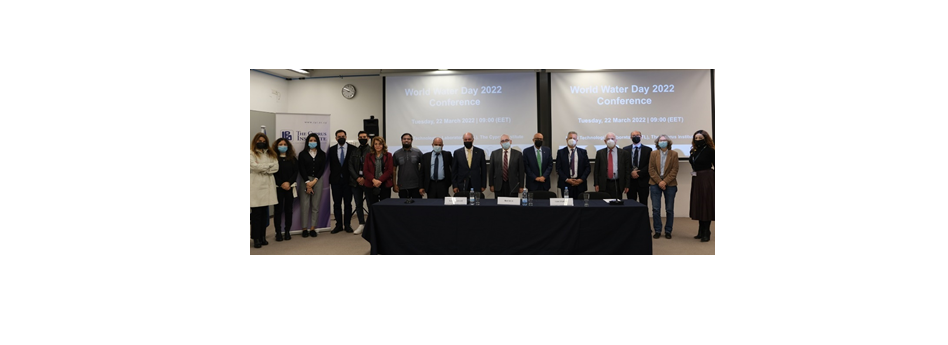
The Cyprus Institute (CyI) World Water Day Conference took place at The Cyprus Institute on 22nd March 2022. The event, part of the Mediterranean process for the 9th World Water forum held in Dakar from 21st to 26th March 2022, was attended by approximately 50 participants, representing national administrations, international UN organizations, NGOs, Universities, Research Centers, Mediterranean initiatives relevant to water resources management in the EMME (Eastern Mediterranean and Middle East) region and Mediterranean countries.
The event was organized under the auspices and the presence of:
- Head of the Department of Multilateral Relations and International Organizations of the Ministry of Foreign Affairs, Mr Giorgos Ioannides, on behalf of the Permanent Secretary of the Ministry of Foreign Affairs of Cyprus, H.E. Ambassador, Kornelios S. Korneliou.
- The Ambassador of France to Cyprus, H. E. Ms. Salina Grenet-Catalano.
- Gianna Oikonomidou, on behalf of the Minister of Agriculture, Rural Development and Environment, H.E. Dr. Costas Kadis.
The key panelists were:
- Diplomatic guests: E. H. Janabi, H.E. Dr. Raed Abou-Soud, H.E. Prof. Mohamed Abdulrazzak, and H.E. Charafat Afilal.
- Scientific guests: M. Scoullos, Prof. Isam Shahrour, Prof. Ilan Juran, Prof. Maria Mimikou, Dr. Carol Chouchani Cherfane, Prof. Gonzalo Espinoza, Ms. Cleopatra Kitti, and Dr. Rana Qaimari.
- Cyprus Water Development Department: Panayiota Hadjigeorgiou.
- CyI representatives: Prof. Costas N. Papanicolas (President of The Cyprus Institute), Prof. Fadi Comair, Prof. Andriana Bruggeman, Dr Nicolas Jarraud.
This meeting focused on (i) water security and hydro-diplomacy, (ii) climate change adaptation for water security, and (iii) water innovations and initiatives, with reference to the need for an integrated Water-Energy-Food-Ecosystems (WEFE) Nexus approach across the Mediterranean.
All of these themes were examined with particular emphasis on their relevance to the EMME region, thus connecting with the Report of the Water Task Force of the EMME-Climate Change Initiative (CCI), which is coordinated by the Cyprus Government. A preliminary version of the report had been presented at the 2nd International Conference on Climate Change in the Eastern Mediterranean and Middle East, held in Paphos between 13th and 14th October 2021.
In his welcoming address, Prof. Costas Papanicolas stated that the water situation in the entire EMME region is not good and unfortunately it is forecasted that is getting worse. We are not catching up with the evolving climate crisis and CyI scientists forecast that business as usual, will reduce rainfall down to 30-40%, towards the end of this century, while demand will double. “If we don’t act now, this will lead to a disaster that are beyond comprehension. This will lead to the collapse of agriculture, the collapse of economy, to a huge migration. The only thing we have to do is prevent it”, he said.
In his opening statement, the Head of the Department of Multilateral Relations and International Organizations of the Ministry of Foreign Affairs, Mr Giorgos Ioannides, highlighted that violent conflicts are breaking out of control over water resources have been with us throughout history. Climate Change acting as a crisis multiplier has exacerbated water related problems. Such tensions have the potential to become even more pronounced in regions where water scarce, such as our EMME region.
The Ambassador of France to Cyprus, H.E. Ms. Salina Grenet-Catalano said that water is more than ever a global challenge, as well as a common good to be shared and a vital resource to be managed sustainably. Access in water has become a major geopolitical issue. EMME region is in immediate danger as regular water shortages will increase in the coming years and will increase the security threats of the region. This is the reason why hydro-diplomacy and all innovative solutions on water security have a significant role to play.
In her opening speech, Ms. Gianna Oikonomidou, mentioned that water is vital for the resilience of both society’s and environment, and is a prerequisite for human nutrition and health, agricultural, ecosystem management, energy, and overall planetary security. Achieving sustainable water resources management, preventing waters scarcity and flood events, and ensuring access to save water and sanitation, when the world is increasingly affected by the key global challenges – Climate Change and growing population.
EEWRC Director Prof. Fadi Comair, an expert on hydro-diplomacy and the keynote speaker of the first main panel discussion on “Water Security and Hydro-diplomacy in the EMME region” noted that nowadays the availability of transboundary water resources is a factor of tension and conflict. 40% of the world’s population feeds water in 214 basins and share transboundary lakes and aquifers. Unilateral management (Harmon Doctrine) and the absence of cooperation policies among the riparian countries discourage the achievement of water peace. Transboundary water is currently at the heart of debates between the states of EMME region, and is now on the agenda of their environmental diplomacy.
Keynote speaker, Director of the Water Department Ms. Panayiota Hadjigeorgiou, highlighted that water availability has always been a major challenge for Cyprus as the water resources of the island are limited and depend mainly on rainfall. Cyprus is amongst the EU countries with the highest Water Stress Index (~73%). Particularly, statistical analysis reveals a stepped drop of 15% in precipitation since the early 70’s, resulted in a drop of 40% in river runoff. According to IPCC, Cyprus is highly vulnerable to the impact of Climate Change and classified as one of the global “hotspots”.
“We have to focus on a sustainable water recourses management to achieve water security and resilience. We have to recognise the limitations on water availability, to educate people to change their consumption and lifestyles, to reflect the real value of water and the need for financial sustainability, to develop energy efficient desalination plants, to support research and innovation, to build Climate Change resilient utilities and upgrade our infrastructure, and to enhance cooperation and knowledge exchange with water professionals and Institutions between the EMME region”, she concluded.
Keynote speaker, Prof. Isam Chahrour added that one of the bigger problems with water resources management is the complexity of the water system itself. “We have to find a solution, provide high quality services, while protecting the water resources and the aquatic systems”. Prof. Chahrour also presented the “SmartWater4Europe” project and its results, regarding an effective, comprehensive, smart solution on water resources management challenge.
In his closing remarks, H.E. Dr Raed Abou-Soud, Former Minister of Water and Irrigation of Jordan, expressed his gratitude to The Cyprus Institute for organizing this Conference.
The conference closed with the participants agreeing to a common World Water Day Declaration, which is reproduced below.
The participants of the 1st CyI World Water Day Conference highlighted the following:
- In view of increasing challenges in the region, related to population growth, climate change, changing lifestyles and unsustainable consumption and production patterns, the scarce water resources of the region are becoming even further stressed. To address these challenges, the EMME region needs parallel action at various levels: effective water demand management; improved and advanced management approaches; innovative technologies for the minimization of water losses and effective use of energy; promotion and wise use of non-conventional water resources; appropriate regulatory frameworks; adequate funding; international cooperation; and comprehensive education and awareness raising campaigns.
- International cooperation is of utmost importance for the region because of its many shared, across national borders, water resources. Implementation of the relevant UN Conventions, in conjunction with hydro-diplomacy and the consideration of the Water-Energy-Food-Ecosystem Nexus, could offer the necessary framework for such cooperation.
- Dialogue and mutual agreement is considered as the only viable way for resolving conflict over transboundary water. Emphasis should be given to promoting (i) coordination at different levels from local, to national (i.e. Basin organization) and regional, (ii) legally binding frameworks (UN conventions), (iii) Promotion of hydro-diplomacy awareness towards decision makers for nations where there is a need for capacity building and the need for developing guidelines for Transboundary Basin Management, and (iv) the recognition that conflict resolution between riparian states should be addressed from the perspective of “water for peace” rather than “war for water”.
- Acknowledge The Cyprus Institute’s new initiative for a Hydro-Diplomacy Partnership Programme-HPP. A non-partisan international platform, which is badly needed, will be put at the service of policy makers, scientists and diplomats, having at its disposal a pool of competencies concerning transboundary water management. This HPP initiative will offer science-based and technologically sound solutions to policy-makers for mitigating water-related risks. This approach will also identify ways to transform water-related conflict into water, energy and food-related cooperation. Activities will include:
- Facilitation of dialogue at a technical level for water sharing options.
- State-of the art modeling capabilities and an extensive repository of relevant observations and data.
- Training of policy makers (water management, conflict resolution), training of scientists (advocacy, diplomacy) with a resulting certificate of “water diplomat”.
- Repository of best practices to be shared throughout the region by adopting innovative approaches based on technological processes with the development of scientific data sets and tools around environmental degradation, climate change projections, water scarcity and water balances for the EMME Region.
- Supporting the implementation of the UNESCO-ECOMED Academy Network based at the Cyprus Institute with, as a secretary, the W-Smart International Alliance of Water & Wastewater Utilities for Sustainable Water Security. It targets the information exchange for extreme events adaptation, experience sharing and capacity building, pollution monitoring, research projects on innovative solutions, and strategic partnerships with regional and UN organizations.
- The participants, acknowledge and strongly support the creation of a regional action plan (for the EMME countries) as part of the Climate Change Initiative (CCI) which is scheduled to be presented to the Ministerial Meeting held in Cyprus on June 2022. The synergy of the envisioned Climate Action Plan and the CyI led “Hydro-Diplomacy Partnership Programme-HPP” is viewed as of critical importance.
- The participants request that the present Declaration is considered as a regional input of the EMME region to the 9th World Water Council Meeting in Dakar.
Source: The Cyprus Institute (https://bit.ly/36CX5d1)