
- Posted 26-Oct-2021
Cyprus University of Technology: Participation of the "MNEMOSYNE" project of CUT in an International Conference on Industrial Heritage in Taiwan.
A great honor and recognition of the great work he performs around the world, is the participation and presentation of the project MNEMOSYNE of the Cyprus University of Technology (CUT), at an International Conference in Taiwan, on Industrial Heritage.
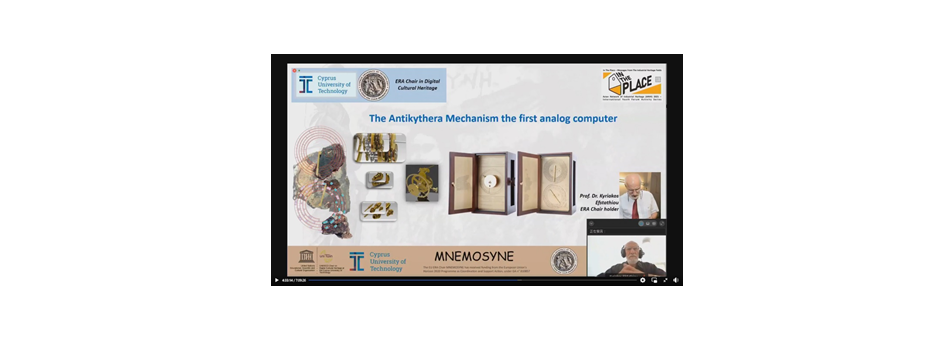
In an online lecture held on October 8, 2021, the holder of the chair of the European Research Area in Digital Heritage Research Laboratory (acronym MNEMOSYNE) of CUT and Emeritus Professor of Mechanical Engineering, Aristotle University of Thessaloniki, Kyriakos Efstathiou developed the project MEMORY.
The main goal of the project is to promote the research field of Digital Cultural Heritage in Europe and to create a corresponding Center of Excellence.
Dr. Efstathiou presented the structure and the main goals of MNEMOSYNE as well as technology-engineering milestones in ancient Greece, which under the right conditions could be the trigger of the industrial revolution 1700 years earlier.
He also analyzed, among others, the piston pump of Ktisiviou and the aeolipile of Heron of Alexandrinos, the first engine to work with steam. He explained that by using a pulley and a belt or by means of gears the rotational motion created by the aeolipile could be transferred to other devices eg to a crank by automating the Ktisivi pump or to the axis of rotation of another machine by starting it industrial revolution at the beginning of the 1st century AD.
He then referred in detail to the Antikythera Mechanism, the most important among the case studies of the MNEMOSYNE project.
The Antikythera Mechanism is the most important landmark of ancient Greek technology, the most complex museum object and one of the most important archaeological finds in the world. It was an analogue computer of amazing technology, the first computer ever built.
It was built about 2150 years ago and was used to accurately calculate the position of the Sun, the Moon and possibly the planets in the sky. He calculated the phases of the Moon, predicted eclipses and determined the date of the ancient panHellenic games. It is as important for the evolution of Technology as the Acropolis for the evolution of Architecture. The complexity of the Antikythera Mechanism is far greater than that of all man-made devices over the next millennium.
Dr. Efstathiou pointed out that the new data and the results of the research conducted by CUT, in collaboration with the Aristotle University of Thessaloniki, show, support the decision, that the Antikythera Mechanism was a scientific instrument for safe predictions of astronomical phenomena and not just a educational tool for the schools of astronomy of antiquity.
"From all the tests that have been performed, the conclusion is that the Mechanism accurately predicts the astronomical phenomena of the future and confirms with astonishing accuracy the astronomical phenomena of the past," he concluded.
Source: Cyprus University of Technology (https://rb.gy/dlwelu)
Τεχνολογικό Πανεπιστήμιο Κύπρου: Συμμετοχή του έργου «ΜΝΗΜΟΣΥΝΗ» του ΤΕΠΑΚ σε Διεθνές Συνέδριο για τη Βιομηχανική Κληρονομιά στην Taiwan.
Μεγάλη τιμή και αναγνώριση του σπουδαίου έργου που επιτελεί ανά το παγκόσμιο, αποτελεί η συμμετοχή και η παρουσίαση, του έργου ΜΝΗΜΟΣΥΝΗ του Τεχνολογικού Πανεπιστημίου Κύπρου (ΤΕΠΑΚ), σε Διεθνές Συνέδριο στην Taiwan, με θέμα τη Βιομηχανική Κληρονομιά.
Σε διαδικτυακή διάλεξη που πραγματοποιήθηκε στις 8 Οκτωβρίου 2021, ο κάτοχος της έδρας του Ευρωπαϊκού Ερευνητικού Χώρου στην Ψηφιακή Πολιτιστική Κληρονομιά (ακρωνύμιο ΜΝΗΜΟΣΥΝΗ) του ΤΕΠΑΚ και Ομότιμος Καθηγητής Μηχανολογίας του Αριστοτέλειου Πανεπιστημίου Θεσσαλονίκης, Δρ. Κυριάκος Ευσταθίου ανέπτυξε το έργο ΜΝΗΜΟΣΥΝΗ.
Το Έργο έχει ως βασικό στόχο να προωθήσει τον ερευνητικό τομέα της Ψηφιακής Πολιτιστικής Κληρονομιάς στην Ευρώπη και να δημιουργήσει ένα αντίστοιχο Κέντρο Αριστείας.
Ο Δρ. Ευσταθίου παρουσίασε τη δομή και τους βασικούς στόχους της ΜΝΗΜΟΣΥΝΗΣ καθώς και ορόσημα τεχνολογίας-μηχανολογίας στην αρχαία Ελλάδα, τα οποία κάτω από τις κατάλληλες συνθήκες θα μπορούσαν να αποτελέσουν το έναυσμα της βιομηχανικής επανάστασης 1700 χρόνια νωρίτερα.
Ανέλυσε επίσης, μεταξύ άλλων, την εμβολοφόρο αντλία του Κτησιβίου και την αιολόσφαιρα του Ήρωνα του Αλεξανδρινού, της πρώτης μηχανής που δούλευε με ατμό. Εξήγησε πως με τη χρήση μιας τροχαλίας κι ενός ιμάντα ή με τη βοήθεια γραναζιών η περιστροφική κίνηση που δημιουργούσε η αιολόσφαιρα, θα μπορούσε να μεταφερθεί σε άλλες διατάξεις π.χ σε ένα στρόφαλο αυτοματοποιώντας την αντλία του Κτησιβίου ή στον άξονα περιστροφής μιας άλλης μηχανής εκκινώντας τη βιομηχανική επανάσταση στις αρχές του 1ου αιώνα μ.Χ.
Στη συνέχεια αναφέρθηκε λεπτομερώς στον Μηχανισμό των Αντικυθήρων, την πιο σημαντική μεταξύ των περιπτωσιολογικών μελετών του έργου ΜΝΗΜΟΣΥΝΗ.
Ο Μηχανισμός των Αντικυθήρων είναι το σημαντικότερο ορόσημο της αρχαίας Ελληνικής τεχνολογίας, το πολυπλοκότερο μουσειακό αντικείμενο και ένα από τα πιο σημαντικά αρχαιολογικά ευρήματα παγκοσμίως. Ήταν ένας αναλογικός υπολογιστής εκπληκτικής τεχνολογίας, ο πρώτος υπολογιστής που κατασκευάστηκε ποτέ. Κατασκευάστηκε πριν από περίπου 2150 χρόνια και χρησιμοποιείτο για τον ακριβή υπολογισμό της θέσης του Ήλιου, της Σελήνης και πιθανώς, των πλανητών, στον ουρανό. Υπολόγιζε τις φάσεις της Σελήνης, προέβλεπε εκλείψεις και προσδιόριζε την ημερομηνία τέλεσης των αρχαίων πανελληνίων αγώνων. Είναι τόσο σημαντικός για την εξέλιξη της Τεχνολογίας, όσο και η Ακρόπολη για την εξέλιξη της Αρχιτεκτονικής. Η πολυπλοκότητα του Μηχανισμού των Αντικυθήρων είναι πολύ μεγαλύτερη από αυτήν όλων των συσκευών που κατασκεύασε ο άνθρωπος κατά την επόμενη χιλιετία.
Πηγή: Τεχνολογικό Πανεπιστήμιο Κύπρου (https://rb.gy/dlwelu)