
- Posted 06-Apr-2020
Last Horizon 2020 Space research call receives 200 project proposals
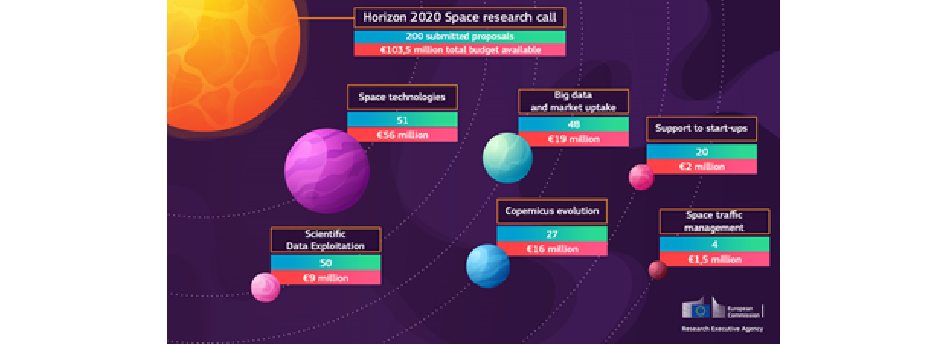
The Research Executive Agency has received 200 proposals for the last Horizon 2020 space research call, which closed on 5 March 2020. The call includes topics in the areas of Earth Observation, space business and entrepreneurship, developing European space technologies, scientific data exploitation, and space traffic management.
75 of the submitted project proposals concern the European Union’s COPERNICUS Earth observation programme. Copernicus produces a wealth of data and information services on the Earth, its lands including inland waters, atmosphere and oceans, as well as on climate change and in support of emergency management and security. Copernicus data and information services are available with free and open data access.
The call invited researchers to propose projects both to improve Copernicus’ core services, but also to capitalise on the data it produces, and use Big Data processing and linking technologies, machine learning and artificial intelligence (AI) in order to add value and provide products and services based on that data.
48 of these projects seek to capitalise on Copernicus’ Earth Observation data:
- 20 projects to develop new products and services using the data;
- 28 projects which concern the use of Big Data tech and AI to help analyse and manage Copernicus data;
27 of these projects focus on improving Copernicus:
- 23 projects to improve Copernicus’ core services;
- 3 projects on better water monitoring with Copernicus;
- 1 project on the calibration and validation strategy for the Copernicus sentinels.
Another 71 of the project proposals received aim to boost Europe’s space sector, with proposals to accelerate the growth of scale-ups and commercialisation, ensure non-dependence and competitiveness of Europe in space, and develop new technologies, with a particular focus on electrical propulsion, space robotics technologies and satellite communication technologies:
- 20 projects seek to support start-ups, scale-ups and entrepreneurs in the space sector;
- 51 projects seek to design, improve or develop vital space technologies:
- 14 concern the non-dependence and competitiveness of European supply chains for critical space technologies;
- 6 concern advances in robotics for future on-orbit missions and exploration of other planets.
- 8 concern electrical propulsion for in-space operations and transportation.
- 23 concern satellite communication technologies.
A further 50 project proposals were made to analyse and make use of data from European missions and instruments, with the aim of combining or correlating data to add value, and producing more scientific publications based on Europe’s space data.
Finally, 4 project proposals were made on the topic of space traffic management which responds to the recent dramatic increase in space actors and lower threshold for access to space, and a subsequent increase in the number of objects in orbit in the near future.
With a total of €103.5 million available, evaluation results are expected to be communicated to applicants in July 2020.
Source: Research Executive Agency News (https://bit.ly/3bSMCXQ)